Why Would Anyone Buy The Stream Ring When the Index 01 Exists?
Is the ability to charge a ring worth an additional $165?
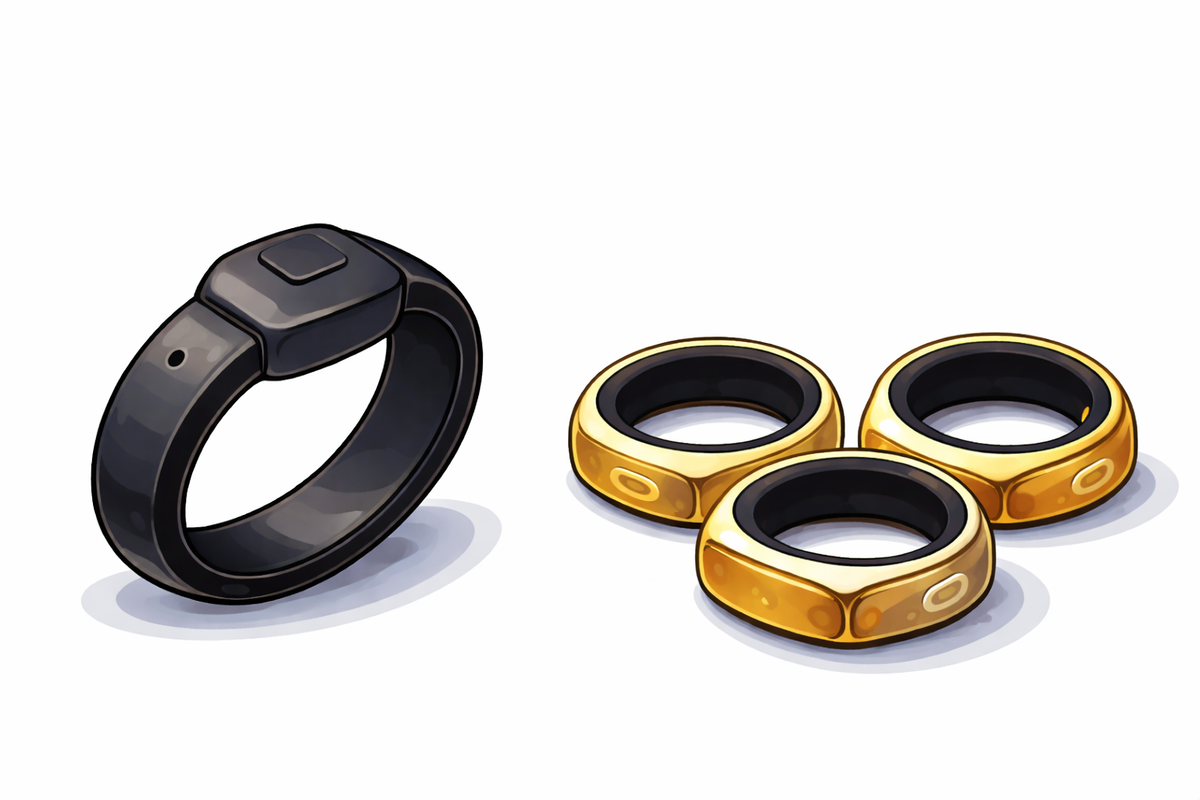
The stream ring is a £180 ($249) ring for those who want a device for "capturing thoughts & building ideas.". Announced in November 2025 by Sandbar, the ring records your voice, transcribes it and lets you have conversations with their built-in AI chatbot.
It has its own proprietary app (of course it does), a subscription for its AI-enhanced features (...of course it does), "all day battery", and a touch-sensitive surface for media controls.
A month later, Eric Migicovsky of Pebble and now Core Devices fame announced the index 01. The index 01 is a £56($75) ring. It has a clicky button, connects to the pebble app, and contains an on-device transcription model (likely whisper based). The device's battery lasts up to two years then you recycle it and buy a new one.
I'm not the first person to note the dichotomy between these two adjacent projects at two very different price points:
TechCrunch called out the price gap. Android Authority noted that Sandbar's ring "isn't a wholly new idea." Yanko Design observed that the Index "inverts every variable." But every comparison stopped at the same surface-level conclusion: The Index is the budget option, the Stream is the premium one.
The Stream gives you a rechargeable battery, an AI chatbot with a personalised voice clone, and a touch-sensitive surface for media control. Index gives you a physical button, a non-rechargeable battery that lasts two years, and local-only processing with no subscription.
The conventional conclusion is that you are choosing between simplicity and capability. The Index captures thoughts. The Stream captures thoughts and thinks back at you. If you want the conversation, you pay the premium.
When talking about the index 01, Eric has taken great pains to emphasise that the purpose of the Index 01 is to remind you of things, so that's the answer right?
Well...
MCP Support
To cut a long story short, the Model Context Protocol allows an AI model to use tools.
I'm aware it's not quite that simple but the purpose of this article is to compare the value proposition between these two products. You will need to do your own research if you would like a fully featured explanation.
The pebble app will run local MCPs via WASM which any MCP server can connect to. Completely open source, and free for the community to bend to their use cases. In fact, the default actions (reminders, notes, alarms) are implemented as MCPs. You have a program with an MCP server? Connect it, now your index can interface with it.
Webhook support + Single/Double Click Actions
Your program doesn't have an MCP server? Cool. Route your audio via webhook to wherever your heart so desires.
You think a general purpose agent in the pebble app may be useful? So do they. Want to route your voice to your own preferred AI? They understand. Both are future plans.
Want to program the button to do something else completely? A little tricky on the iPhone, but they'll work with the tools they are given.
The Index is essentially an open source voice input device, with enough tools to do something useful or even novel as long as you can reason out a sensible implementation.
The Competition
Let's flip back to the Stream Ring and their £186.91 ($249) + $7.51 ($10) a month offering.
The ring looks very premium, but at its core it is:
1. a proprietary AI chatbot,
2. a proprietary transcription pipeline
3. a proprietary note taking app, separate to your own current note taking practice
4. an unproven inner voice feature
This is exactly the architecture that has killed every AI hardware product of the last two years.
The pattern Silicon Valley doesn't seem to see?
Humane raised $230 million to build an AI Pin that coupled custom hardware to a proprietary AI service. HP acquired the remains for $116 million in February 2025, and the device was bricked within days.
Rabbit sold 100,000-130,000 R1 units, watched 95% of users abandon the device, and by late 2025 couldn't make payroll.
Friend launched a $129 always-listening pendant and shipped barely a thousand units.
In all of these cases, the hardware was actually interesting. Not as interesting as a ring, but interesting in their own right. But if you couple good hardware to questionable software, the software will sink that ship every single time.
Every one of these products welded a specific AI service to a specific piece of hardware, then bet that their AI would be good enough, for long enough, to justify the form factor.
...Bless them.
The AI space is moving at such a rapid pace that commoditising your own specific AI model is often DOA. Add in that the people who use AI already have their own preferred model set up with their preferences and projects and your specific forced app and AI implementation are often squarely in the compromise part of the purchase equation.
Pebble's Index 01 sidesteps this entirely. The ring doesn't care what AI you use. It captures audio, sends it where you tell it to, and gets out of the way.
Want to use Pebble's local LLM for simple note categorisation? Fine.
Want to use Obsidian-MCP and a local AI model to transcribe and categorise your audio notes into your obsidian vault with the rest of your written notes? Have a blast!
Tomorrow it might be Claude processing your voice notes into a structured daily brief.
Next year it might be something that doesn't exist yet. The ring doesn't need to change. The ring doesn't need a software update. The ring just works. The ring will last for two years, put it on, set it up, don't think about it again.
The economics of open vs. closed
The numbers are brutal for Stream.
Index 01 costs £56.30 ($75) during preorder, £74.31 ($99) after March 2026. No subscription. No charging. Ships globally, works on iOS and Android. The battery lasts two years of typical use — around 20 short recordings per day. When it dies, you recycle it and buy another one. Total two-year cost: $75. $37.50 a year, or cheaper than the cost of a special edition Moleskine notebook.
Stream costs £186.91 ($249) for silver, £224.44 ($299) for gold. The Pro subscription, which unlocks unlimited chats and the full AI feature set, runs £7.51 ($10) per month after the initial 3 free months. It requires daily charging. iOS only at launch. US only at launch. Ships summer 2026, months after the Index. Total two-year cost with Pro: $249 + $210 = $459.
Without pro, you could still buy 6 years' worth of time with the index. With pro? you'd never break even.
That's a roughly 3-6x price difference (with pro vs without) for a device whose primary advantage, built-in AI conversation, will likely be replicated on the Index by connecting it to any of the dozens of AI services that already exist and are improving monthly.
But even the cost comparison undersells the Index's advantage. The real gap is in what happens when the AI landscape shifts.
Stream users are locked to Sandbar's model and Sandbar's roadmap. Index users will be able to switch their backend intelligence whenever they want, at no additional hardware cost. The open architecture means the ring appreciates in capability over time as the ecosystem around it improves, without Pebble having to do anything.
Okay... But Charging?
For those of you who saw that the Index 01 didn't charge and closed the tab, I see you and your feelings are valid. Tech trash and planned obsolescence suck and the economics working out in your favour compared to the competition doesn't make that not the case.
Those of you who are older might remember the original tile tracking devices and their ReTile program. (For the uninitiated, you would send your tile back once the battery died and you would receive a nominal discount on your replacement purchase). I have emailed the Pebble team to ask if they were considering offering a sort of "ReIndex program".
Provided the devices are efficiently and effectively recycled, this should hopefully decrease the amount of these devices which end up in landfill. Without an incentive to send the device back to pebble, I'm not convinced I would bother sending it back... I actually still have my original tile so even with the incentive I might still not bother!
I will update this article with any responses I get regarding that possibility.
Why Did You Write All Of This?
The people most likely to want a voice-capture ring: the people who lose thoughts between having them and writing them down, people who need frictionless capture while their hands are full, people with ADHD or executive function challenges who benefit from externalising their working memory are precisely the people who can least afford unnecessary friction.
Daily charging is friction. A subscription is friction. Platform lock-in is friction. Being told your AI assistant works one way and only one way is friction. Is this note in obsidian with the rest of my notes or in my voice notes app? Friction.
A ring that never dies, never needs a cable, works offline, processes locally, and lets you route your voice to whatever systems you actually use for organising your life — that's the opposite of friction. That's the tool disappearing into your routine, which is the entire point.
The Real Take Away
The Stream ring isn't a bad product. The team's background in neural interfaces is legitimately impressive. The voice clone feature may turn out to be impressive. The conversational AI loop, if it works well, could be genuinely useful for some people.
But "could be useful for some people" is not a defensible market position when a $75 open alternative exists that lets those same people connect to whatever AI model they prefer. Sandbar is betting that their proprietary AI experience is worth an up to 6x premium (with the monthly subscription) over a device that can do everything theirs does — and more — through its open architecture.
The AI hardware graveyard is full of companies that made exactly that bet. Pebble, characteristically, just built the simplest possible thing and left the side door open.
That side door is exciting, I'm planning to walk right in as soon as I'm given the chance. For those choosing between these two rings, do you want to rent someone else's chosen AI, or plug in your own?